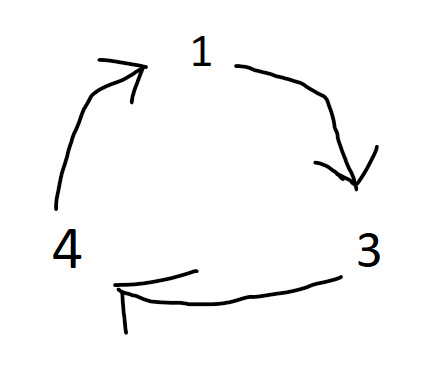
We express the permutations in
\(\ss_{n}\) with exactly
\(k\) cycles as
\(A_n\uplus B_n\text{,}\) a disjoint union where
\(B_n\) are the permutations with
\(n\) contained in a cycle of length one, while
\(A_n\) are those permutations where
\(n\) is contained in a cycle of length at least two.
For each permutation in
\(B_n\text{,}\) if we remove the one-cycle containing
\(n\text{,}\) then what remains is a permutation in
\(\ss_{n-1}\) with
\(k-1\) cycles. This accounts for
\(c(n-1,k-1)\) permutations, which is the second summand in our recursion.
For each permutation in
\(A_n\text{,}\) if we remove
\(n\) from the cycle containing it, we obtain a permutation
\(\sigma\in\ss_{n-1}\) with
\(k\) cycles. Each such
\(\sigma\) can be obtained from
\((n-1)\) different permutations in
\(A_n\text{,}\) since there are
\((n-1)\) positions in
\(\sigma\) where
\(n\) could be inserted to obtain an element of
\(A_n\text{.}\) Thus, there are
\((n-1)c(n,k-1)\) permutations in
\(A_n\text{,}\) which is the first summand in our recursion.