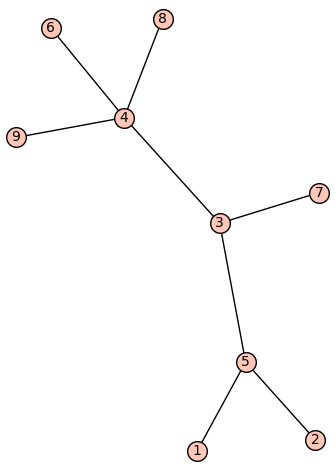
Seymour’s second neighborhood problem is an open problem in mathematics, meaning that it is a problem that has not been solved by anyone. Let
\(G\) be a graph without loops or multiple edges. Assign to every edge a direction, that is, for each edge
\(\{i,j\}\text{,}\) either direct the edge from
\(i\) to
\(j\) or the opposite. This turns
\(G\) into a
directed graph.
The
first neighborhood of a vertex
\(v\) in a directed graph is the set of all vertices that are at distance one from
\(v\) (this means there must be an edge pointing from
\(v\) to the neighbor). The
second neighborhood of
\(v\) is the set of all vertices that are at distance two from
\(v\text{.}\) Note that these two sets are disjoint, and neither contains
\(v\text{.}\)
The open problem is as follows: For every directed graph
\(G\text{,}\) does there exist a vertex
\(v\) such that the second neighborhood is at least as large as the first neighborhood?
Make as much progress as you can on this open problem; I don’t expect you to find a solution, but you should spend 2-3 hours thinking about this! Your goal is to do something more than check examples; the examples should lead you to make some interesting observations about the problem, to understand it a bit better. Why do you think it might be true? Why might it be false? Are there any properties of directed graphs that support your comments? Are there any directed graphs for which this is obviously true? You can do this using only pencil and paper, or using mostly computational experiments, or you can use a mix of these. However, you need to provide a narrative in sentences/paragraphs explaining your thinking and the results of your investigations. (Seriously, write down everything you’re thinking and every idea you try, even if it doesn’t go anywhere.)